
Handmade wooden urns for ashes
I make urns one at a time in my Baltimore shop, from wood I mill and dry myself. Each one is built for one person or one animal, so the wood, the size and the finish are chosen with you rather than picked from a catalogue.
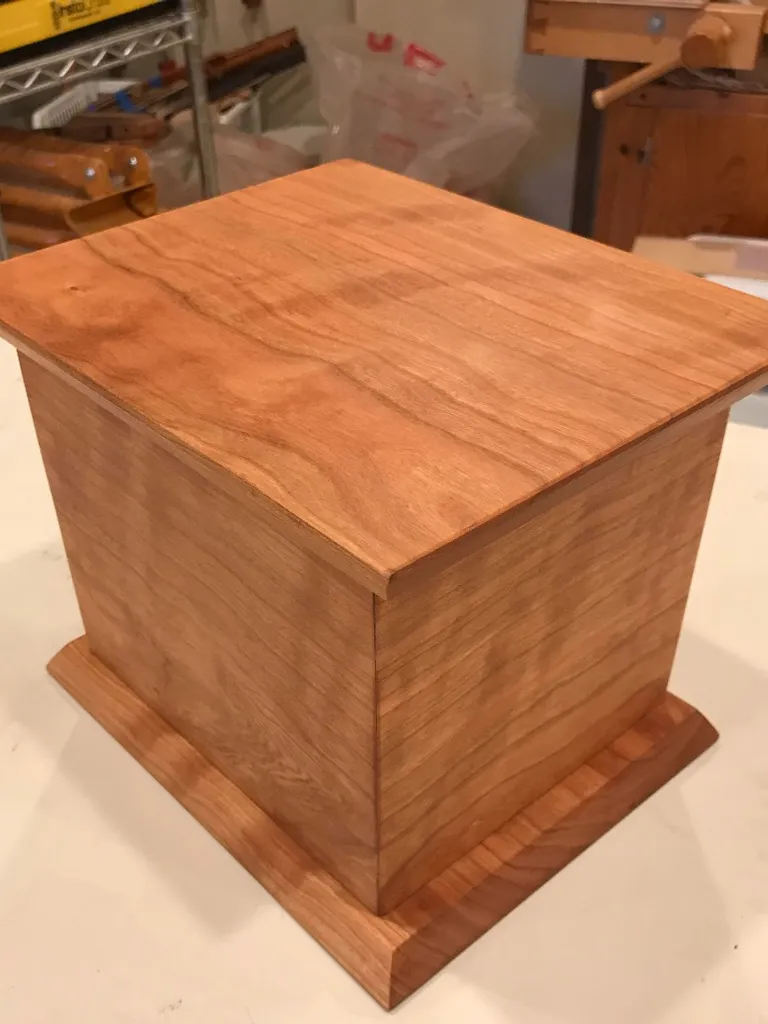
The cherry urn in the photograph
That urn started as a cherry tree that came down in a storm at a customer's house. I went over, cut a big section of the trunk, milled it into slabs and boards, and let them dry. Two and a half to three years later the wood was ready, and it became this urn. Mill to urn, one tree, one pair of hands.
Because I do every step myself, an urn can come from a tree your family planted, climbed or sat under. How a piece from your own tree works.
What I make
- Full-size urns. Sized to hold an adult's ashes, about 200 cubic inches inside. The largest urn I have built is full adult size.
- Urns for pets. The urns I have made so far have both been for dogs: the full-size one, and a smaller one in maple for my sister's dog.
- Keepsake urns. Smaller pieces for a shelf, or to share a portion between family members.
The wood
Every urn starts with the wood, and I am glad to show you boards before anything is cut. Most of what I work comes from trees that had to come down for some reason. These are the woods I use most, and what each one does over time.
- Cherry starts pale pink and darkens to a deep red brown within the first year or two in the light. An urn that sits by a window will change the most.
- Walnut is dark chocolate brown from the start and mellows slightly lighter with age. A classic choice for a formal piece.
- White oak has a tight grain and stands up to moisture, which is why it was used for barrels and ships. Cut a certain way, it shows a ribbon pattern called ray fleck that no stain can copy.
- Red oak is more open grained and warmer in colour than white oak.
- Maple is pale, hard and smooth. Some boards carry a ripple called curl that catches the light.
- Ash is light coloured with a bold grain. The emerald ash borer has been killing ash trees across Maryland, so much of the ash I work comes from trees that had to come down.
- Elm and hickory, both strong and both with plenty of character in the grain.
- Pine is the traditional wood for a simple box: light, soft and honest about every knot.
- Spalted wood carries dark lines drawn by a natural fungus. Caught at the right moment and dried properly, it is some of the most striking wood there is.
- Reclaimed wood, from barns, old floors and storm-felled trees, carries nail holes and old marks. Most people choose it for exactly that.
How it is made
All wood, no metal. The corners are joined with dovetails or mortise and tenon, a peg cut on one piece that fits a hole cut in the other, so nothing needs a screw.
The ashes go in a bag inside the urn. Most of my urns close with a snug drop-down lid with no hinge; a hinged lid or a sliding panel is possible if you prefer. For a green burial, the bag has to be biodegradable rather than plastic.
Names, dates and personal touches
A name and dates can be carved by hand or laser engraved, set in a brass or bronze plaque, or branded into the wood with an iron. Tell me what you would like it to say.
How long it takes
Weeks rather than days for an urn from wood I already have dried. From your own tree it takes longer, because the wood has to dry first: at least two months from felling, using a kiln, and years if it air dries.
If you need an urn for a service in the next few days, the funeral home or crematory can provide a temporary container, and the ashes can be moved into a handmade urn later. Nothing is lost by waiting for the right piece.
Buying an urn from a maker rather than the funeral home
Under the Federal Trade Commission's Funeral Rule, a funeral home cannot refuse an urn you bought elsewhere and cannot charge you a fee for using it.What a funeral home must accept.
Questions people ask
- Can a wooden urn be buried?
- Yes. My urns are solid wood with no metal, joined with dovetails or mortise and tenon, so they break down over time. For a green or natural burial, the ashes go in a biodegradable bag rather than a plastic one; ask your burial ground what else they require.
- How do the ashes go in?
- The ashes go in a bag inside the urn, and the lid closes over them. Most of my urns have a snug drop-down lid with no hinge. A hinged lid or a sliding panel is possible if you prefer one.
- Can I send the ashes to you?
- I would rather not handle ashes. Most families keep them, and once the urn arrives your funeral home can transfer the ashes for you.
- Do you ship?
- Yes. I am based in Baltimore, I deliver across central Maryland and Washington DC, and I crate and ship anywhere in the country at your cost.
- What does an urn cost?
- Every urn is quoted to its own wood, size and work, so there is no price list. Tell me what you have in mind and I will give you a number.
- How big should an adult urn be?
- The usual rule is one cubic inch of space for every pound of body weight before cremation, so about 200 cubic inches holds most adults. I build to that, or larger if you need it.
Start an urn
Tell me who it is for, what wood you have in mind, and whether there is a tree it should come from.
Start a commission(443) 534-7457tyler@oakleafcustomwoodworking.com